
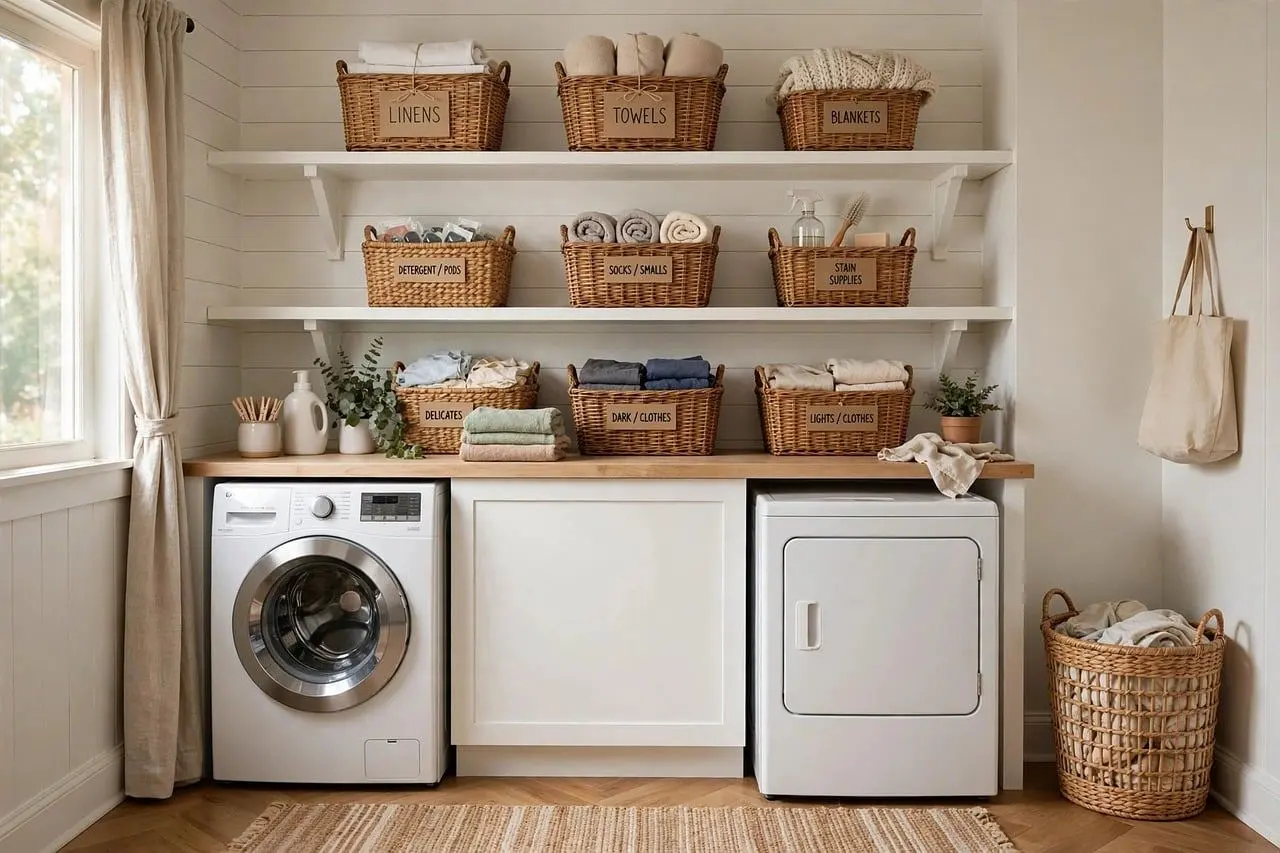
Short on space and tired of piles? The best laundry room organization ideas start with clear zones, vertical storage and a clutter-free dryer. You can do it in a closet or a full room, and keep it safe too.
For the bigger picture across every room, see the guide to home organization.
| Item | Value |
|---|---|
| Clothes dryer fires each year (CPSC figure) | 15,500 fires |
| Property damage from those fires | over $84 million |
| Average fires involving dryers, 2014 – 2018 (NFPA) | 13,820 fires |
| Deep-clean the lint trap with a nylon brush | every six months |
| Clean dryer venting (U.S. Fire Administration) | every three months |
| Replace washing machine supply lines | every three to five years |
These figures come from the U.S. National Park Service and State Farm. They can change, so check the sources before you rely on them.
Plan around zones before you buy bins
A laundry room works best when the workflow is visible at a glance. Place each stage within a step or two of the next, and clutter has fewer places to land.
Before you add storage, clear out what does not belong. If the room has turned into a dumping ground, the method in this guide on how to declutter your home helps you decide what stays.
Then lay the room out in the order you actually work:
- Dirty: a hamper or sorting baskets near the door, so clothes never pile on the floor.
- Wash: the machine with detergent and stain remover within arm’s reach.
- Dry: the dryer with a clear area around it.
- Fold: a flat surface, such as a countertop, a board over the machines or a fold-down shelf.
- Put away: a hanging rod and one labelled basket per person.
How do you organize a small laundry room or closet?
In a small space, vertical storage is your main resource because the floor is already taken by the machines. Use the wall above them and the back of the door before anything else.
- Mount a shelf above the washer and dryer for lidded baskets holding detergent, dryer sheets and stain treatments.
- Hang an over-the-door rack or hooks for lint rollers, mesh bags and a small broom.
- Fit a tension rod or a wall-mounted drying rack for delicates and hang-dry items.
- Choose a slim rolling cart only where the gap is wide enough to pull it out without squeezing past the machines.
- If you are buying machines, a stacked pair frees floor space for a hamper.
Leave room around the dryer even when space is tight. Its manual should tell you the space a dryer needs for proper airflow, and State Farm advises keeping the area around it clutter-free.
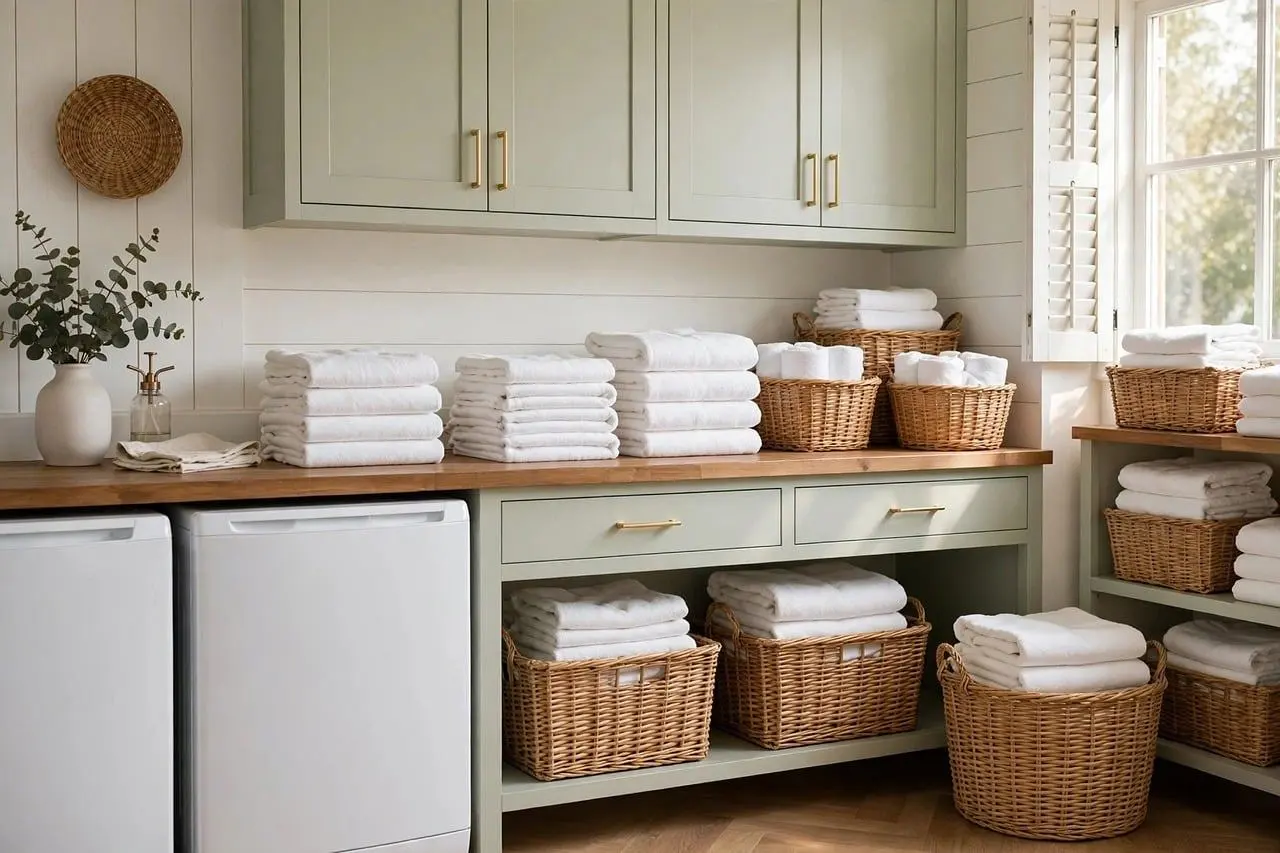
Ideas for medium and large laundry rooms
With more room, the aim shifts from squeezing things in to keeping surfaces clear. A few well-placed pieces do more than a wall of shelving.
Build a proper folding counter
A counter over front-loading machines, or a freestanding table, gives you a place to fold straight from the dryer. Keep it empty between loads so it stays useful.
Give each person a basket or shelf
Labelled baskets let everyone collect and carry their own clean clothes. It also stops the single pile of unclaimed socks from growing.
Add closed storage for the messy items
Cabinets hide cleaning supplies, spare bulbs and tools, and they keep the room looking calm. Seasonal blankets and spare sheets can live elsewhere, and these under bed storage ideas show one place to keep them.
Plan a sink and a drying zone
A utility sink with a pull-out or ceiling-mounted rack handles hand washing and dripping garments. Gas, plumbing and electrical changes need a licensed professional.
Safety rules that shape the layout
The layout matters because dryers are a real fire source. The U.S. National Park Service, citing the U.S. Consumer Product Safety Commission, reports 15,500 clothes dryer fires annually, with over $84 million in property damage.
State Farm, citing National Fire Protection Association research, gives an average of 13,820 fires involving dryers in 2014 – 2018. Lint buildup is a major cause, so build upkeep into the room:
- Clean the lint screen before or after each load, as the National Park Service advises.
- Use rigid or flexible metal venting from the dryer to the wall outlet, not plastic.
- Keep items soiled with gasoline, cooking oil or grease out of the dryer.
- Brush the lint trap every six months and clean venting every three months, per State Farm.
- Keep a fire extinguisher close.
Chemicals need their own plan. Keep detergents, packets, bleach and softeners in their original containers, out of reach of children and pets. State Farm cites the American Association of Poison Control Centers: as of July 31, 2022, centers had managed 5,582 cases of laundry detergent packet exposure in children 5 and younger.
Water is the other risk. The same State Farm guide suggests setting the washer in a pan connected to a drain, and replacing supply lines every three to five years. Post your local poison control number where everyone can see it.
A short weekly reset
Organization only lasts if the upkeep is quick. A short weekly routine is usually enough to keep the room under control.
- Wipe up spills right away, because soapy detergent can cause falls.
- Empty the lint screen and wipe the dryer top.
- Return stray baskets and bottles to their shelves.
- Clear the fold surface so it is ready for the next load.
Frequently asked questions
What is the cheapest way to organize a laundry room?
Show answer
Begin with what you own: baskets, a tension rod, a few hooks and a hamper. Group items by stage of the wash, label the baskets and add shelves only if something still has no home.
Where should detergent be stored?
Show answer
Keep it in the container it came in, high up or behind a closed cabinet door. Stain-remover sprays should be stored away too, since a spray bottle can be a source of accidental poisoning.
Can I put shelves or a cart next to the dryer?
Show answer
Yes, provided the manual’s airflow clearance is respected and nothing blocks the vent or its duct. Check the outside vent opening for leaves or nests from time to time.
How do I know when the dryer vent needs cleaning?
Show answer
A slower dryer, or lint drifting around the room, is the cue. State Farm suggests hiring professionals, and says homes with pets or a large family may need this as often as twice a year.